
Why Google’s Universal Cart is the Death of Traditional E-Commerce: The End of the "Tabs" Era

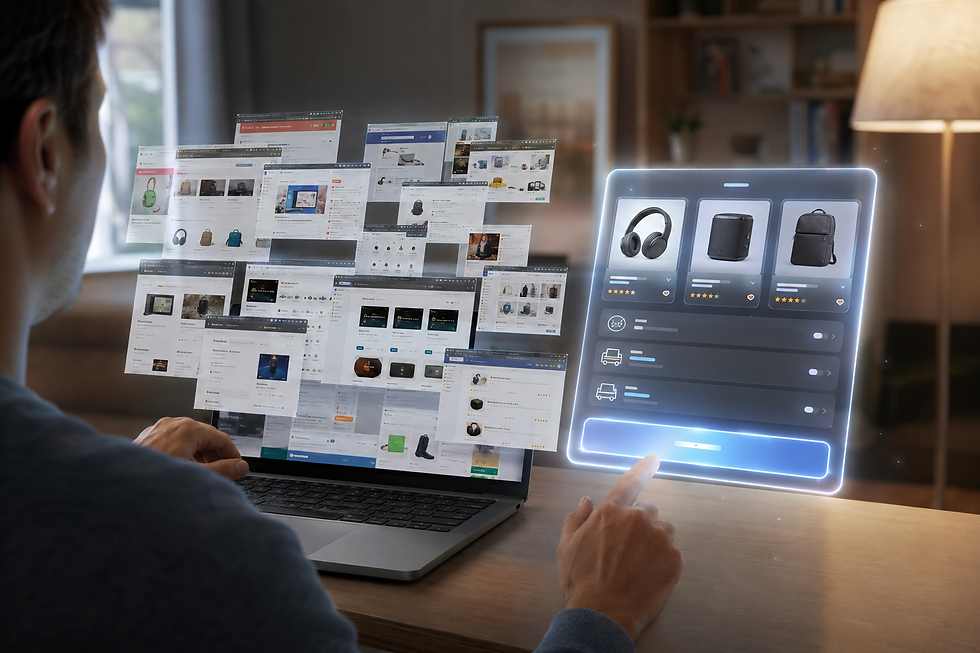
The fundamental "User Interface" of retail just changed forever.
At Google I/O 2026, we witnessed a shift that most retailers are not prepared for. We are moving away from the "Search and Click" era, where humans hunt for products across dozens of open browser tabs, and entering the Agentic Era, where AI agents manage the entire lifecycle of a purchase.
Google has officially laid the high-speed rails for autonomous shopping. Here are the five pillars of that new infrastructure and what they mean for the future of your business.
1. The Universal Cart: Commerce Without Borders
The shopping cart is no longer a "place" on your website; it is a persistent, AI-powered hub that follows the user across the entire Google ecosystem—Search, Gemini, YouTube, and Gmail.
This isn't just a unified list of items; it is a Reasoning Engine.
Dynamic Intelligence: The cart tracks price drops and restock alerts in real-time.
Compatibility Logic: Gemini now performs "pre-purchase audits." For example, if a user adds a specific PC processor to their cart, Gemini will cross-reference the motherboard's technical specs against those already in the cart and flag an incompatibility before any money is spent.
2. Agent Payments Protocol (AP2): The Infrastructure of Trust
This is the "plumbing" for the future. Google’s updated Agent Payments Protocol (AP2) provides the secure framework for AI agents to make purchases within user-defined guardrails.
This isn't glorified "Auto-fill." AP2 is a verifiable, tamper-proof record that allows an agent to settle a transaction on a user’s behalf.
The Risk: For AP2 to work, the data must be Deterministic. An AI agent will not "guess" at a price if the metadata is ambiguous. To protect the user, the agent will simply abort.
3. Beyond the Cart: The Rise of the "Proactive Agent."
Google didn't just give us a cart; they gave us Search Agents and Gemini Spark.
These are employees you manage. Users can now command agents to:
Search Agents: Monitor the web 24/7. "Buy this specific SKU the second it hits $400."
Gemini Spark: Manage long-running tasks, like planning an entire home renovation and purchasing all materials across 15 different vendors autonomously.
If your data doesn't provide a Deterministic Handshake, these agents will skip your store in favor of one that is "Agent-Ready."
4. Generative Virtual Try-On (VTO): Visual Fiduciary Data
Google is expanding its Generative AI Virtual Try-On to more apparel categories and home decor. Using Gemini Omni, Google can now simulate how a garment fits or how furniture looks in a specific room with high fidelity.
The Merchant Impact: For VTO to work, the agent needs exact geometrical and material data. If your product specs are hidden in static images or unoptimized PDFs, you’ll be flagged as "Unknown Fit," and the agent will nudge the user toward a competitor with cleaner "Digital Twin" metadata.
5. UCP Expansion: A Global Language for Machines
Google is doubling down on the Universal Commerce Protocol (UCP) as the "common language" for AI-driven commerce. With expansion into Canada, Australia, and new verticals like travel and food delivery, UCP is becoming the global standard for machine-to-machine trade.
The Verdict: Discovery is the Prequel, Settlement is the Goal
For years, the industry has been obsessed with AEO (Answer Engine Optimization), getting the AI to "mention" your brand. Google I/O just proved that "being mentioned" is no longer enough.
The goal is now Settlement. The "Merchant of Record" still belongs to you, but the Customer Journey is being pulled into the Google ecosystem. For your brand to survive this shift, your product data can no longer be "just okay." It must be Agent-Ready.
The Mid-Market Gap
Google is launching these pilots with giants like Nike, Sephora, and Walmart. They have the massive engineering teams required to bridge their legacy systems to the Universal Cart manually.
But what about everyone else?
The real battle for the future of retail will be fought in the mid-market. If you aren't one of the "chosen" pilot brands, you need a partner to build your bridge to the Universal Cart before you get left behind.
How to Get Agent-Ready
At TF Labs, we specialize in building the bridge between legacy e-commerce stacks and the new Agentic infrastructure. We don't just help you get found; we ensure you are transactable.
We help brands move from human-readable "vibes" to machine-readable Truth Sets, ensuring that when a Google Agent reaches out to your store, the handshake is successful and the sale is settled.
The rails are being laid. Is your storefront ready for the train?
If you’re a brand or retailer looking to audit your "Agentic Readiness," let’s talk. Comment below or send us a message to schedule a free diagnostic session.
Contact us at info@tflabs.io


Comments