
What are AEO and GEO and how do they work with traditional SEO?


For over two decades, SEO was the primary mechanism for gaining digital visibility. The rules were relatively clear: research keywords, optimize content, build authority, and compete for clicks on a search results page.
Today, users no longer always search. Now, they ask.
Instead of opening ten links and manually comparing information, they interact with AI-powered answer engines like ChatGPT, Gemini, Perplexity, or Google's AI Overviews.
Behavior has changed: people want immediate, contextualized, and actionable answers.
This shift is redefining how brands gain attention.
It's no longer enough to simply appear in Google search results. Now, it's also important to be the source that an AI considers reliable in constructing an answer.
In this new landscape, two key concepts emerge: AEO (Answer Engine Optimization) and GEO (Generative Engine Optimization).
However, there's a significant misconception here: many believe that AEO and GEO replace SEO. This is a mistake.
What is AEO (Answer Engine Optimization)?

AEO stands for Answer Engine Optimization. Its goal isn't just to rank on Google. Its goal is: To be the answer.
AEO seeks to optimize content so that answer engines, virtual assistants, and conversational experiences select your information as a primary source.
This includes ecosystems such as:
AI-powered chatbots
Voice assistants
Google Featured Snippets
AI Overviews
Conversational engines
Algorithmic trust. In other words: Does your content deserve to be cited as an answer?
How AEO works:
AEO prioritizes content that is:
Clear
Precise
Structured
Contextual
Scannable
Semantically rich
For example: An article optimized for traditional SEO might focus on repeatedly inserting keywords. Meanwhile, content optimized for AEO would directly answer specific questions:
AEO is an optimization strategy that helps AI-powered search engines use your content to answer user questions.
This clear answer format increases the likelihood of being picked up by search engine optimization (SEO) systems.
In AEO, a new KPI emerges: being quoted or summarized by search engines. The user might never visit your site, but your brand still influences their decision.
What is GEO (Generative Engine Optimization)?
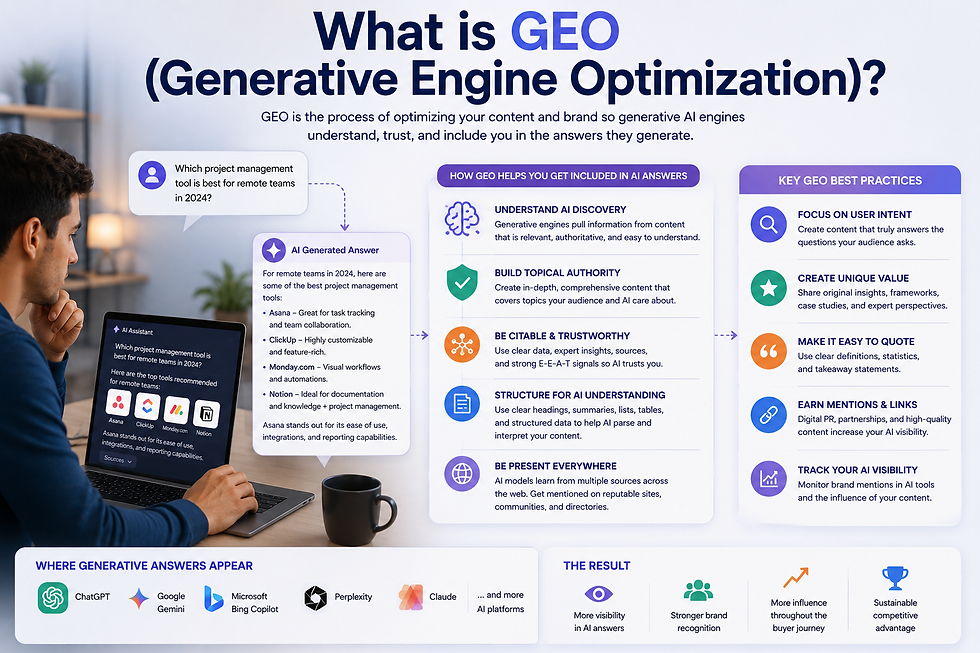
While AEO optimizes for search engines, GEO takes the logic a step further.
The goal of GEO is to increase the likelihood that generative models will use, understand, reference, or recommend your brand within dynamically generated search results.
Here, we're no longer just talking about Google. We're talking about ecosystems like OpenAI, Google, Anthropic, or discovery engines based on LLMs (Learning Management Models).
How GEO Works
Unlike traditional SEO, GEO doesn't rely solely on rankings. It depends on signals such as:
1. Subject Authority: AI prioritizes expert and consistent sources.
It's not enough to publish a lot. You must demonstrate depth.
2. Semantic Context: AI understands conceptual relationships. Your content must address complete topics, not just isolated keywords.
3. Citability: The models favor content that is:
Well-structured
With clear definitions
In-depth explanations
Verifiable data
Recognized authority
4. Omnichannel presence: AI doesn't just read your website.
It also considers:
Blogs
Whitepapers
Technical publications
Third-party mentions
Forums
Documentation
Specialized media
In GEO, visibility is more like a digital reputation network.
The easiest way to understand it is this:
SEO helps you get found.
AEO helps you get answers.
GEO helps you get AI-powered recommendations.
They don't compete. They complement each other.
If you want to create your own strategy, we'll share our tips in the next blog post.
Stay tuned!
Contact us at info@tflabs.io



Comments